The Future of AI in Business Automation
· 6 min read · Faiz Khan
Explore how artificial intelligence is transforming business processes and enabling organizations to automate complex workflows.
Faiz Khan
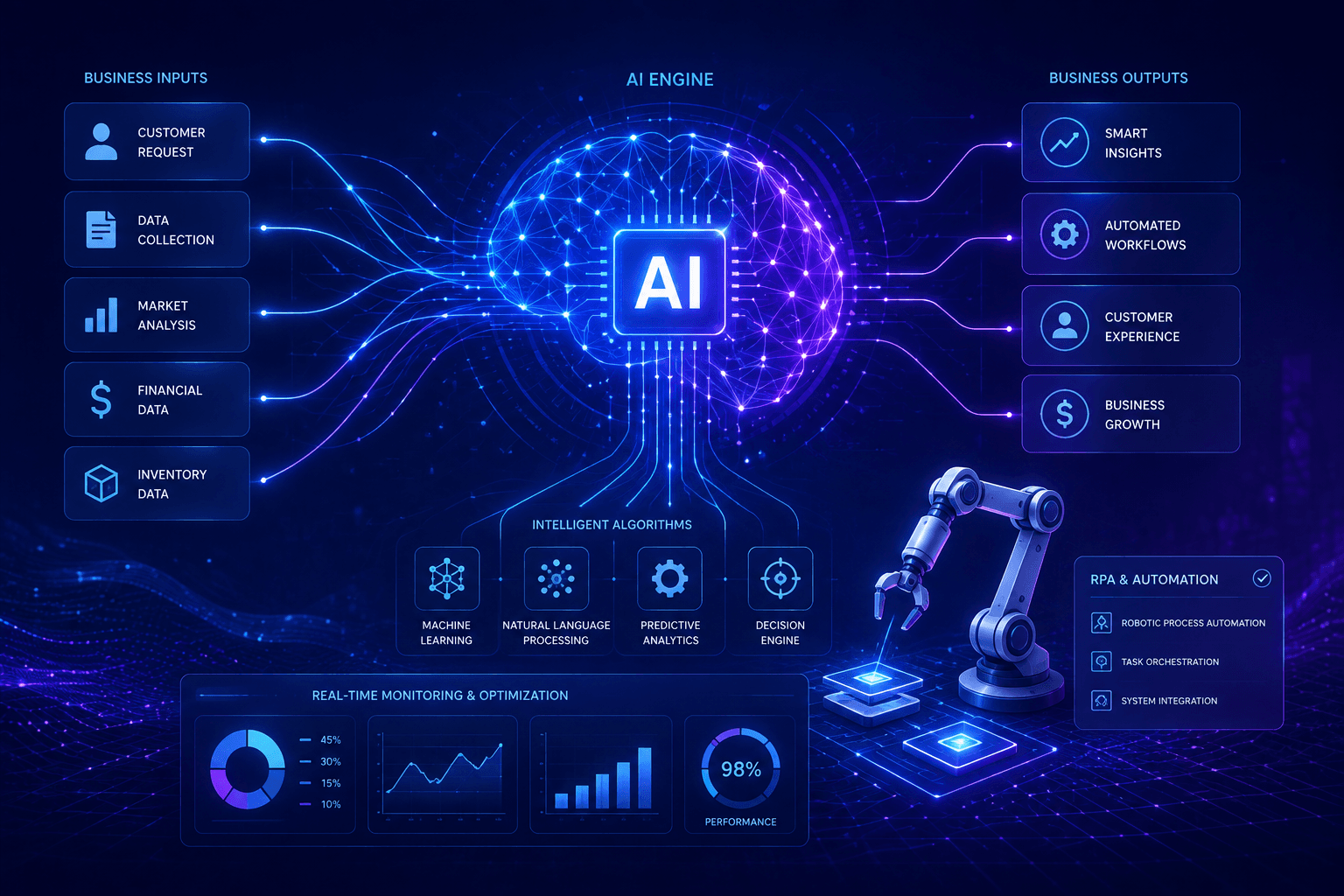
Artificial Intelligence is no longer a distant future technology—it's actively transforming how businesses operate today. From intelligent automation to predictive analytics, AI is enabling organizations to work smarter and more efficiently. Companies that embrace AI now are gaining competitive advantages that will be difficult for others to catch up with.
The most immediate impact of AI has been in automating repetitive, rule-based tasks. Invoice processing, data entry, customer service responses—these are areas where AI excels. Unlike traditional automation, which requires explicit programming for every scenario, AI learns from data and improves over time. This means AI systems can handle exceptions and edge cases that traditional automation would fail on.
But the real power of AI in business automation goes deeper than replacing repetitive work. AI enables companies to automate decision-making processes that were previously thought to require human judgment. Credit approval, fraud detection, inventory optimization—AI systems now make these decisions faster and often more accurately than humans. This frees up team members to focus on strategy and customer relationships rather than processing transactions.
Predictive analytics powered by AI is transforming how businesses plan. Instead of reacting to what happened last quarter, companies can now predict customer churn, equipment failures, demand fluctuations, and market trends. This shift from reactive to proactive management is creating genuine competitive advantages. A manufacturing company that predicts equipment failure before it happens avoids costly downtime. A retailer that predicts demand accurately optimizes inventory and reduces waste.
The human element remains crucial. AI works best when it augments human decision-making rather than replacing it. A loan officer with AI assistance can process more applications more accurately than either AI or the officer alone. Customer service teams with AI tools can handle more complex issues because the system handles routine inquiries. The future of AI in business isn't about removing people—it's about making them more effective.
As AI becomes more sophisticated, the competitive landscape will shift. Companies that master AI-powered automation will operate with lower costs, higher quality, better customer experience, and faster decision-making. The question isn't whether to adopt AI—it's how to do it in a way that aligns with your business strategy and transforms your operations for sustainable competitive advantage.
Stay Updated
Receive practical insights, engineering perspectives, and business-focused technology articles delivered as new content becomes available.
Looking For Guidance On Your Next Project?
Whether you're exploring new technology, planning a digital product, or solving a business challenge, we'd be happy to discuss your goals and help you identify the right approach.